
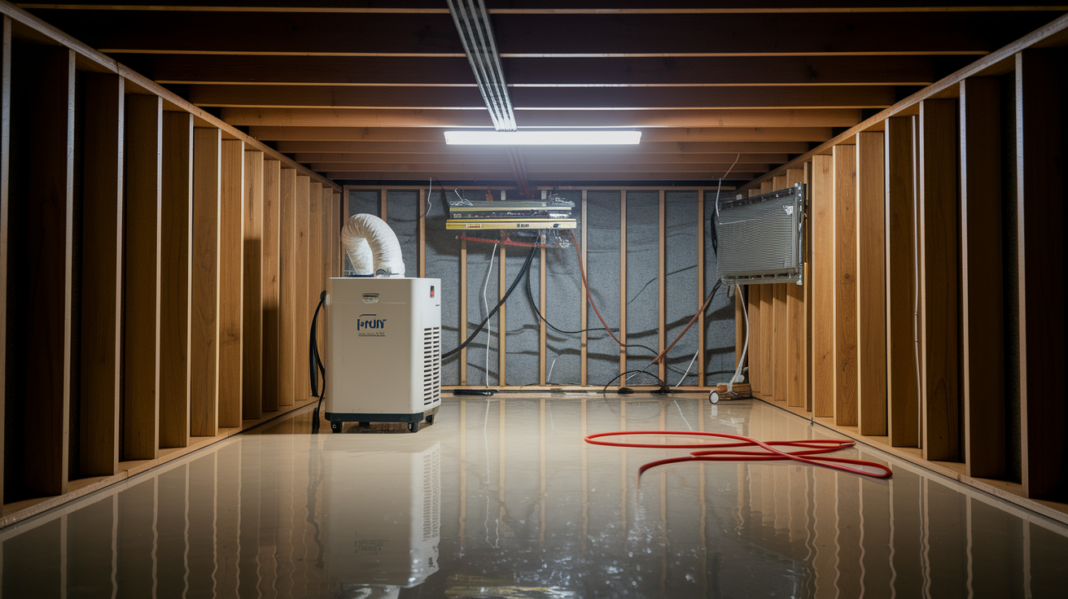

Think a box-store dehumidifier will save a wet crawlspace? Think again.
Crawlspace wood and subfloor must be below 20% moisture before mold and joists warp.
That takes LGR or desiccant dehumidifiers, high-volume air movers, pumps, lay-flat ducting, vapor barriers, and daily moisture checks.
This post walks you through the right equipment, where to place it, and the simple steps we use to stop more damage, finish repairs, and document everything for insurance.
Core Overview of Crawlspace Drying Equipment and What You Need to Know

Crawlspace drying equipment pulls moisture out of wood framing, subfloors, and insulation after leaks, floods, or plumbing failures. You’re trying to get structural materials below 20% moisture content before mold sets in or joists start warping. This takes commercial grade dehumidifiers, high volume air movers, pumps for standing water, and monitoring tools to track progress every day. A residential unit made for a bedroom won’t cut it. The equipment needs to handle tight spaces, high humidity, and sometimes cold temps where consumer models just shut down.
IICRC S500-2021 standards tell you to focus on drying structural wood and building materials, not the soil under a vapor barrier. Many crawlspaces qualify as confined spaces under OSHA 29 CFR 1926 Subpart AA, which means you need negative pressure established before you enter, proper PPE, and photos of any hazards before work starts. Negative pressure gets created by placing an air mover in front of an exterior vent to pull air out, not by running a filtration machine. Once it’s safe to go in, you pump out standing water, pull wet debris and insulation, then set up dehumidification and airflow equipment aimed at the wood above.
Here’s what you need for a real crawlspace drying job:
Dehumidifiers: low grain refrigerant (LGR) or desiccant units rated 50 to 200+ pints per day, picked based on temperature and how wet things are
Air movers and fans: centrifugal or axial models pushing 1,000 to 4,000 CFM to move moisture off surfaces and into dehumidifier intakes
Submersible and condensate pumps: to pull standing water out and handle dehumidifier discharge when gravity drains aren’t an option
Monitoring tools: penetrating moisture meters, digital hygrometers, infrared thermometers to document moisture content and humidity daily
Ducting and distribution gear: lay flat ducting with perforations to deliver dry air where dehumidifiers can’t physically fit
Vapor barrier materials: 6 to 20 mil polyethylene sheeting, tape, and fasteners to control evaporation from wet soil
Choosing the Right Crawlspace Dehumidifier and Capacity Ratings

You’ve got three main dehumidifier types. Standard refrigerant, low grain refrigerant (LGR), and desiccant. Standard refrigerant units work fine in warm, humid conditions but lose steam below 65°F. LGR dehumidifiers use a second coil pass to pull more moisture from the air and handle cooler crawlspaces better, which is why restoration contractors lean on them. Desiccant dehumidifiers use a rotating wheel of moisture absorbing material and function in temps as low as 33°F. That makes them your best bet for unheated crawlspaces in winter or cold climates where refrigerant units would ice up and quit.
Capacity gets measured in pints per day, rated under standardized AHAM test conditions (usually 80°F and 60% RH). A 50 pint unit will pull roughly 50 pints of water in 24 hours under those conditions, but real world performance changes with temperature, airflow, and starting humidity. For crawlspace sizing, figure 1 dehumidifier per 500 to 1,000 square feet of wet area, depending on how bad it is. Light dampness in a 600 square foot crawlspace might dry with a 50 pint LGR unit and a few air movers in 3 to 5 days. Severe saturation in that same space may need a 120 pint commercial unit or two smaller LGRs running at once, plus pulling standing water and yanking wet insulation. That could take 1 to 3 weeks to hit safe moisture levels.
When you’re picking a dehumidifier, confirm these five specs before you deploy it:
Operating temperature range and automatic defrost features
Condensate handling method (gravity drain port, internal reservoir size, or condensate pump connection)
Amperage draw so you know your power circuit can handle it without tripping breakers
AHAM or manufacturer pints per day rating, ideally tested at crawlspace type conditions
Filter type and replacement schedule (washable filters cut operating costs on long jobs)
| Dehumidifier Type | Ideal Conditions | Typical Capacity Range |
|---|---|---|
| Standard Refrigerant | Warm, high humidity spaces above 65°F | 30–70 pints/day |
| Low Grain Refrigerant (LGR) | Cool to moderate temps, faster drying required | 70–150 pints/day |
| Desiccant | Cold crawlspaces below 60°F, winter jobs | 50–200+ pints/day |
Air Movers, High CFM Fans, and Evaporation Enhancement in Crawlspaces

Air movers create airflow across wet wood surfaces, which speeds up evaporation by moving moisture loaded air toward the dehumidifier intake. Without airflow, a dehumidifier alone pulls moisture slowly because the air near the wet surface gets saturated and stops evaporating. Industry guidelines say one air mover per room (in this case, one per crawlspace) plus one more for every 100 to 150 square feet of wet subfloor or joist surface. CFM ratings (cubic feet per minute) run from 1,000 to 4,000 depending on fan type and speed setting. Axial fans deliver high CFM in a focused column of air and work well in crawlspaces with clear sight lines. Centrifugal air movers produce pressure and throw air in multiple directions, making them better for low clearance or obstructed spaces where you need airflow to wrap around posts and ductwork.
Placement matters just as much as CFM. Position air movers so airflow runs parallel to the vapor barrier and pushes moisture toward the dehumidifier. Don’t aim fans at foundation walls where airflow just bounces back. In long or divided crawlspaces, place units every 8 to 15 linear feet to prevent dead air pockets where moisture hangs around. If the dehumidifier sits outside the crawlspace because of clearance limits, use lay flat ducting with holes cut every 2 feet to distribute dry air along the subfloor and joists. Check that total air mover CFM doesn’t overwhelm dehumidifier intake capacity. Running four high speed air movers on a single 70 pint unit forces the dehumidifier to process more air than it can dehumidify, which slows moisture removal instead of speeding it up.
Pumps, Condensate Handling, and Drainage Planning for Crawlspace Drying

Standing water has to come out before drying equipment can do anything. Submersible utility pumps move 2,000 to 4,000 gallons per hour and handle pooled water from burst pipes, heavy rain, or failed sump systems. Pick a pump with a float switch so it shuts off automatically when the water level drops, and run discharge hoses to a sump pit, exterior drainage point, or storm drain. Never back into the crawlspace itself. For debris filled water, use a solids handling or trash pump rated for small particles.
Once standing water’s cleared, you still need to manage condensate from the dehumidifier. If the unit sits above a sump pit or floor drain, gravity drainage works. Run a hose from the dehumidifier drain port to the pit. If gravity drainage isn’t possible because the dehumidifier is lower than the drain or separated by distance, install a condensate pump. These small pumps cost $120 to $400, connect to the dehumidifier’s drain port, and lift condensate up to 15 vertical feet through narrow tubing. Most include a float switch to prevent overflow.
Here’s how to set up safe and reliable drainage:
- Pump out all standing water using a submersible pump, starting at the lowest point in the crawlspace.
- Route pump discharge hoses outside the foundation and away from the building to prevent water coming back in.
- Connect the dehumidifier’s condensate drain to a gravity line or condensate pump, depending on elevation and access.
- Secure all hoses with zip ties or clamps to prevent disconnection during operation.
- Check condensate flow daily and clean float switches or pump intakes if flow slows or stops.
Vapor Barriers, Encapsulation Materials, and Crawlspace Insulation Drying

A vapor barrier limits moisture evaporation from wet soil, which matters because you’re drying the wood structure above, not the ground below. If an intact 6 mil or thicker polyethylene barrier already covers the soil, leave it in place and repair any tears or gaps with waterproof construction tape. Don’t remove or puncture a working vapor barrier during drying. If no barrier exists or the current one’s badly damaged, install a temporary 6 mil sheet, overlapping seams by at least 6 inches and taping them to reduce soil moisture entering the air. After drying wraps up, upgrade to a 12 to 20 mil crawlspace grade liner for long term protection.
Wet batt insulation between floor joists holds moisture for weeks and becomes a mold source if you don’t pull it. Yank down any fiberglass or cellulose insulation that’s visibly wet, compressed, or stained. Bag it and dispose of it properly. Closed cell spray foam insulation on rim joists can usually stay put unless it’s saturated or contaminated. Once the crawlspace is dry, you can re-insulate with new batts or switch to foam board or spray foam for better moisture resistance.
Vented crawlspaces complicate drying because outdoor air brings in humidity that fights your dehumidification. If you’re running a dehumidifier, block foundation vents temporarily with foam board or plastic sheeting to create a controlled drying environment. After drying, many contractors recommend permanent encapsulation. That involves sealing vents, installing a continuous vapor barrier, insulating the foundation walls instead of the floor, and conditioning the crawlspace with a permanent dehumidifier or HVAC tie in. This approach prevents recurring moisture issues and improves energy efficiency.
| Barrier Type | Recommended Thickness | Use Case |
|---|---|---|
| Temporary poly sheeting | 6–10 mil | Short term drying jobs, emergency moisture control |
| Permanent encapsulation liner | 12–20 mil | Long term moisture prevention, sealed crawlspace systems |
Monitoring Tools: Moisture Meters, Hygrometers, and Remote Alerts

You can’t confirm drying progress without measuring it. A penetrating moisture meter with pins or probes reads moisture content inside wood joists, subfloors, and sill plates. Readings above 20% tell you the material’s still too wet. Take readings in at least four quadrants of the crawlspace, each covering roughly 100 to 150 square feet, and label them A, B, C, D on your moisture map. Document readings every 12 to 24 hours and photograph the meter display with date and time stamps visible.
A digital hygrometer tracks relative humidity and temperature in the crawlspace air. You want relative humidity between 30% and 50% during active drying, ideally 30% to 45% for long term mold prevention. Many hygrometers also calculate dew point and grains per pound (GPP), which help you understand vapor pressure and drying efficiency. Place hygrometers near the dehumidifier and at the far end of the crawlspace to confirm airflow is distributing dry air evenly. Some units offer Bluetooth or Wi-Fi connectivity so you can monitor conditions remotely and get alerts if humidity spikes or equipment stops.
You need these monitoring tools for crawlspace drying:
Penetrating moisture meter with calibrated scales for wood and concrete
Digital hygrometer or psychrometer with data logging or remote access
Infrared thermometer to check surface temps when using heat drying
Manometer to document negative pressure if contaminated water is present
Installation and Placement Best Practices for Crawlspace Drying Equipment

Power all equipment using GFCI protected circuits to prevent shock hazards in wet conditions. Run extension cords from outdoor outlets or a panel inside the home, routing them through access hatches or crawlspace vents. Don’t lay cords directly on wet vapor barriers. Use cable clips or suspend cords from joists to keep them dry. If multiple dehumidifiers and air movers exceed 15 amps total, split the load across separate circuits or use a power distribution box to prevent breaker trips.
Elevate dehumidifiers and air movers off the vapor barrier using cinder blocks, plastic platforms, or equipment stands. This keeps intakes and motors clear of residual water and prevents damage from accidental splashing. Place the dehumidifier on the warmer side of the crawlspace if you can, since warmer air holds more moisture and improves removal efficiency. Position air movers to aim airflow along the subfloor and joists, directing moist air toward the dehumidifier intake. If the crawlspace is too low for the dehumidifier to fit, set it outside the access opening and duct dry air into the space using 6 to 12 inch lay flat ducting with perforations or holes cut every 2 feet to distribute airflow.
Establish negative pressure before opening crawlspace access by placing an air mover in front of an exterior vent to exhaust air out. This prevents mold spores, odors, and contaminated air from flowing into living spaces. Confirm negative pressure with a manometer if sewage or category 3 water is involved. Once the space is safe to enter, proceed with equipment setup.
Here’s the safe and effective installation process:
- Confirm crawlspace meets confined space safety requirements and establish negative pressure before entry.
- Route GFCI protected power from a dedicated circuit or distribution box to avoid overloads.
- Elevate all equipment on blocks or platforms to keep motors and intakes above residual water.
- Position the dehumidifier centrally or on the warmer side, with clear access to its condensate drain.
- Place air movers every 8 to 15 feet, directing airflow parallel to vapor barriers and toward dehumidifier intakes.
- Install ducting if equipment can’t fit inside the crawlspace, and cut holes every 2 feet for even air distribution.
Rental vs Purchase: Cost Ranges and ROI for Crawlspace Drying Equipment

Rental rates for commercial crawlspace drying equipment typically run $40 to $150 per day for LGR or desiccant dehumidifiers, depending on capacity and local market. Air movers rent for $10 to $30 per day, and submersible pumps cost $20 to $60 per day. Weekly rates usually equal three to five times the daily rate, so a one week job renting one LGR dehumidifier, two air movers, and one pump might total $400 to $700 before tax and delivery fees. For a single emergency job, renting makes sense because you avoid the upfront cost of buying equipment you may never use again.
Purchase prices vary widely based on quality and capacity. Residential dehumidifiers rated 30 to 70 pints per day cost $200 to $700 and work for light moisture control, but they lack the durability and low temperature performance needed for heavy or cold crawlspace jobs. Commercial LGR units range from $1,000 to $3,500 and are built for continuous operation, faster drying, and colder conditions. Professional air movers cost $100 to $500 each. Submersible pumps run $80 to $400, and condensate pumps cost $120 to $400. If you’re a contractor running multiple drying jobs per year, purchasing pays for itself in 3 to 10 jobs depending on rental rates in your area.
| Equipment Type | Average Rental Cost | Average Purchase Price |
|---|---|---|
| LGR/Commercial Dehumidifier | $40–$150/day | $1,000–$3,500 |
| Air Mover/Fan | $10–$30/day | $100–$500 |
| Submersible/Condensate Pump | $20–$60/day | $80–$400 |
For homeowners dealing with recurring moisture problems, buying a permanent crawlspace dehumidifier rated 50 to 70 pints per day and installing it with a condensate pump and vapor barrier system prevents future damage and reduces energy loss. The equipment investment of $500 to $1,200 plus installation labor typically pays back in 2 to 4 years through avoided repair costs and lower HVAC bills.
Troubleshooting and Common Mistakes When Using Crawlspace Drying Equipment

Undersizing the dehumidifier is the most common mistake. A 30 pint residential unit can’t keep up with a 1,200 square foot crawlspace that has standing water and wet insulation. The unit runs continuously but makes little progress because it was designed for a bedroom, not a high moisture confined space. Match dehumidifier capacity to the square footage and moisture severity, and use LGR or desiccant models for crawlspaces below 65°F.
Using air movers without a dehumidifier moves moisture around but doesn’t remove it. The crawlspace feels drier temporarily because air is circulating, but humidity stays high and materials remain wet. Always pair airflow equipment with dehumidification. On the flip side, running too many high CFM air movers on a single dehumidifier overwhelms its intake capacity and reduces moisture removal efficiency. Balance airflow with dehumidifier capacity.
Failing to remove wet insulation or debris extends drying time and increases mold risk. Wet fiberglass batts, cardboard boxes, wood scraps, and organic debris all hold moisture and release it slowly into the air. Remove contaminated or saturated materials before starting equipment. Improper condensate routing is another frequent error. Discharging dehumidifier condensate into the crawlspace or onto the vapor barrier defeats the purpose of drying. Always route condensate to a sump pit, exterior drain, or condensate pump that lifts water outside the foundation.
Errors to avoid during crawlspace drying:
Choosing consumer grade dehumidifiers for commercial scale moisture loads
Running air movers without dehumidifiers in humid climates
Failing to remove wet insulation, debris, or standing water before starting equipment
Discharging condensate into the crawlspace instead of routing it to a drain or sump
Final Words
You set the dehumidifier and aim an air mover along the joists, feeling the room start to change. We covered what gear to use: dehumidifiers (LGR vs desiccant), air movers, pumps, and vapor barriers, plus how to size, place, and drain them safely.
We also walked through monitoring, installation steps, rental vs purchase choices, and common mistakes.
Use documented moisture readings, photos, and a clear plan. With the right crawlspace drying equipment, you’ll stop hidden moisture and get the space back to normal.
FAQ
Q: What is the best way to dry out a crawl space?
A: The best way to dry out a crawl space is to stop the water source, extract standing water, then run commercial dehumidifiers and air movers, install or repair a vapor barrier, and monitor moisture until wood is below 20%.
Q: Are crawlspace dehumidifiers worth it?
A: Crawlspace dehumidifiers are worth it when humidity risks mold, rot, or musty smells; they protect framing and insulation. Pair with a vapor barrier or encapsulation and proper sizing for efficient, long-term results.
Q: Can I put a dehumidifier in my crawl space without encapsulation?
A: You can put a dehumidifier in a crawl space without encapsulation, but it’ll work harder and costs more. Moisture from soil and vents may persist. Encapsulation or at least a ground liner improves effectiveness.
Q: What is the average cost of a crawl space dehumidifier?
A: The average cost of a crawl space dehumidifier ranges widely: $200–$700 for residential units, $1,000–$3,500 for commercial LGR models. Renting runs about $40–$150 per day depending on unit size.