
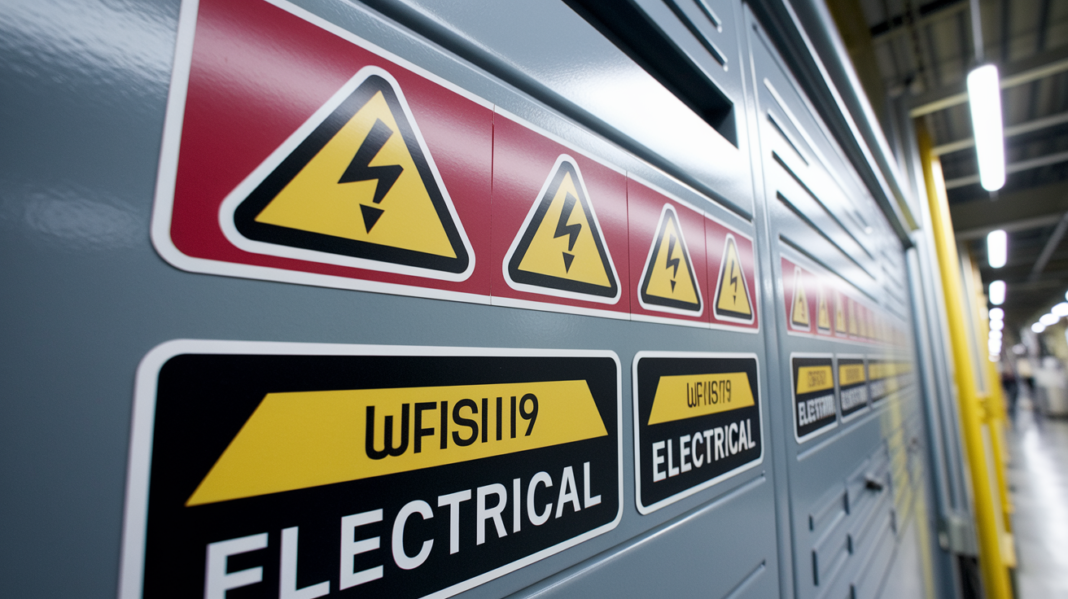

Think a little sticker can’t stop a deadly shock?
Think again.
Clear electrical hazard warning signs stop people from touching energized parts, prevent arc flash injuries, and keep untrained workers out of danger zones.
This post gives safety managers the ten warning signs you must know, explains what each one means, where to put them, and what to document for compliance.
It also ties each sign to OSHA, ANSI, and NFPA rules so your team meets legal and safety standards.
Key Electrical Hazard Warning Sign Types and What They Mean

Every workplace with electrical equipment needs clear, standardized warning signs. These signs prevent contact with energized parts, reduce arc flash injuries, and keep untrained people out of hazard zones. The ten most critical sign types address different scenarios, from high-voltage power distribution to sensitive electronics manufacturing. Each one targets a specific risk with placement rules tied to where accidents happen most.
Understanding what each sign means helps supervisors decide which signs to install and where. High-voltage warnings mark areas where contact with energized conductors or equipment can cause fatal shock. Arc flash signs identify locations where sudden electrical energy release through air could cause severe burns. Ground fault labels point to circuits where a missing or broken grounding path creates hidden electrocution risk, especially in wet environments like kitchens and bathrooms.
Other signs manage access and work procedures. “Do Not Enter When Light Is On” controls entry to spaces with active hazardous machinery. “Electrical Maintenance In Progress” keeps unauthorized workers away during repairs. Static-sensitive device warnings protect delicate electronics from electrostatic discharge that can destroy components or corrupt data.
High Voltage Signs mark power stations, industrial electrical rooms, and commercial building distribution areas where voltage exceeds safe contact levels. They restrict access to qualified personnel only.
Caution: Ground Fault indicates a compromised or broken grounding path. You’ll find these in bathrooms, kitchens, outdoor outlets, and other areas where moisture increases shock risk. They recommend Ground Fault Circuit Interrupters (GFCIs).
Danger: Electrical Shock Hazard appears near exposed wiring, open electrical panels, and machinery under maintenance. It signals the need for appropriate protective gear and lockout procedures.
Danger: Do Not Enter When Light Is On shows up in industrial settings to indicate active hazardous processes or machinery cycles. Employees must be trained to recognize and respect the indicator light.
Warning: Arc Flash Risk gets placed on switchboards, motor control centers, and large industrial electrical panels. These warn of sudden electrical energy release through air that can cause severe burns, injuries, or death. They require specific training and personal protective equipment (PPE).
Warning: Explosive Atmosphere marks areas where flammable gases, vapors, or dust may be present, such as chemical plants, refineries, and grain silos. Electrical equipment in these zones must be specially designed, installed, and maintained. Ventilation must be continuously monitored.
Caution: Live Electrical Parts alerts workers to exposed energized components on panels, junction boxes, and equipment enclosures. Only authorized, trained personnel wearing proper PPE should approach.
Danger: Confined Space identifies spaces not designed for continuous occupancy, with limited entry or exit points, possible hazardous electrical equipment, and poor ventilation. Entry requires permits, atmospheric monitoring, and rescue readiness.
Warning: Electrical Maintenance In Progress are temporary signs that prevent unauthorized entry and accidental contact with live components during active maintenance or repair work.
Caution: Static Sensitive Devices appear in electronics manufacturing, repair facilities, and data centers where electrostatic discharge (ESD) can damage sensitive components. They recommend wrist straps, antistatic mats, and controlled ESD environments.
Recognizing these ten sign types is the first step in preventing electrical accidents. When workers know what a sign means and why it’s there, they follow the warning instead of ignoring it.
OSHA and ANSI Requirements for Electrical Hazard Warning Signs

OSHA requires employers to provide warning signs wherever electrical hazards exist and where contact with energized parts could result in injury. These signs must be visible, legible, and placed before workers enter the hazard zone. While OSHA sets the general requirement, it references voluntary consensus standards like ANSI Z535 for specific design and content rules.
ANSI Z535.2 defines signal words (Danger, Warning, Caution, and Notice) and assigns each to a specific level of risk. Danger indicates situations that will cause death or serious injury if not avoided. Warning signals situations that could result in death or serious injury. Caution marks hazards that may cause minor or moderate injury. Notice addresses property damage or equipment-related information without physical injury risk. Every electrical hazard sign must include the Safety Alert Symbol, a black triangle with an exclamation point, unless the hazard is so well understood that the symbol isn’t needed.
NFPA 70E governs arc flash labeling on electrical equipment rated 50 volts or more. It requires labels to show the nominal system voltage, the arc flash boundary, the minimum PPE rating required at the working distance, the incident energy level or PPE category, and the limited approach boundary for shock protection.
ISO 7010 provides internationally recognized symbols for electrical hazards, including the black lightning bolt inside a yellow triangle. Facilities that operate globally or follow international machinery directives often adopt ISO 7010 symbols to maintain consistency across sites and reduce language barriers.
| Standard | What It Regulates | Example Application |
|---|---|---|
| OSHA 29 CFR 1910.145 | Workplace accident prevention signs and tags | Danger tags on locked-out electrical panels |
| ANSI Z535.2 and Z535.4 | Signal word hierarchy, color rules, and Safety Alert Symbol design | Danger: High Voltage signs with black text on orange background |
| NFPA 70E | Arc flash and shock hazard labeling on electrical equipment | Arc flash labels on motor control centers showing PPE category and boundary distance |
| ISO 7010 | Standardized hazard symbols for international use | Electrical shock hazard symbol (lightning bolt in yellow triangle) on export machinery |
Failure to comply with these standards can result in OSHA citations, fines, and increased liability after an incident. Inspectors look for missing labels during facility audits, especially on electrical panels, disconnects, and arc flash hazard locations. More important, missing or incorrect signs leave workers unaware of hazards they can’t see, which is why regulators treat signage as a core element of electrical safety programs.
Design Specifications for Effective Electrical Hazard Warning Signs

A compliant electrical hazard sign must be seen, read, and understood in seconds. ANSI Z535 specifies color rules that create instant recognition. Orange backgrounds signal danger from energized equipment, yellow indicates general caution, and red marks fire-related electrical hazards or emergency stops. The signal word appears at the top in large, bold letters: Danger in white on black, Warning in black on orange, or Caution in black on yellow.
Below the signal word sits the Safety Alert Symbol, followed by a concise hazard statement like “High Voltage” or “Arc Flash Hazard,” and finally instructions such as “Authorized Personnel Only” or “Wear Required PPE.”
Sign size and legibility depend on viewing distance. A small 2″ x 4″ label works on an electrical panel door viewed from arm’s length. A 10″ x 14″ sign is needed on a substation fence viewed from 20 feet away. The rule of thumb is one inch of letter height for every 50 feet of viewing distance under good lighting.
Reflective sheeting or photoluminescent materials improve visibility in low light or during power outages. Reflective electrical signs use glass bead or microprismatic coatings that bounce light back toward the source, making them visible to flashlight beams or vehicle headlights. Photoluminescent signs absorb ambient light and glow in the dark for up to eight hours, which is critical for marking electrical rooms and exit routes during blackouts.
Font choices matter. Helvetica and Arial provide clean, sans-serif readability. Avoid decorative fonts or condensed type. Text must contrast sharply with the background: black on white, white on black, or black on yellow. Symbols should be large enough to interpret from the maximum expected viewing distance. Every sign element (signal word, symbol, hazard statement, and instruction) must work together to deliver the message in under three seconds.
Essential sign elements for compliance and clarity include signal word sized proportionally larger than body text and placed at the top, standardized symbol (Safety Alert Symbol, ISO 7010 lightning bolt, or arc flash graphic) positioned prominently, high-contrast color combination following ANSI Z535 or ISO standards, clear and concise hazard statement and instruction in simple language readable from the intended distance, plus durable material that resists fading, chemicals, abrasion, and weather exposure for the expected service life.
Placement Rules for Electrical Hazard Warning Signs in Workplaces and Public Spaces

Signs must be placed where workers will see them before entering the hazard zone. On electrical panels and switchgear, mount the label directly on the cabinet door or the access cover so it’s impossible to open the enclosure without reading the warning. For substations and outdoor electrical equipment, attach heavy-gauge aluminum signs to perimeter fencing at intervals no greater than 50 feet, and at every gate or access point. The bottom edge of the sign should sit at least 42 inches above ground level to remain visible above vegetation, snow, or debris.
Overhead power lines require “Danger: High Voltage Overhead” signs posted in areas where cranes, lifts, or tall equipment operate. Place these signs at the entrance to the work zone and on any equipment that could contact the lines. Buried cable locations need visible markers installed on stakes or posts at excavation sites, with labels identifying the voltage level and utility contact information.
Temporary power distribution at construction sites must be marked with weatherproof danger signs at each connection point and along cable runs where vehicles or foot traffic could create contact risk.
Arc flash hazard boundaries require floor markers or barrier tape at the calculated arc flash boundary distance, supplemented with wall-mounted arc flash warning signs on the equipment itself. Motor control centers, switchboards, and panelboards rated 50 volts or higher need arc flash labels positioned so they’re visible to anyone approaching the equipment. ESD protective areas in electronics manufacturing use both wall signs and floor markers to define the controlled zone where wrist straps, antistatic mats, and grounded workstations are mandatory.
Key placement zones include electrical panel doors and cabinet access covers, where labels must be read before the enclosure is opened. Substation perimeter fencing and gates need signs at regular intervals and at every point of entry. Overhead power line work zones require warnings at entry points and on cranes, lifts, or tall equipment. Excavation sites with buried cables need markers on stakes showing voltage and utility contact. Arc flash hazard boundaries call for floor markers at the boundary distance, plus wall signs on the equipment. Temporary power distribution requires weatherproof danger signs at connection points and along exposed cable runs.
Grouping signs near entry points reduces clutter while ensuring visibility. Mounting height, angle, and lighting must allow the sign to be read under the worst conditions: dim light, rain, or when the worker is distracted by other tasks.
Arc Flash Electrical Hazard Signage and How to Read Labels

An arc flash is a sudden release of electrical energy through the air, caused by a fault or short circuit in electrical equipment. The resulting explosion of superheated plasma can reach temperatures over 35,000°F and create pressure waves that throw workers across a room. Arc flash injuries include severe burns, blindness, hearing loss, and blunt trauma. NFPA 70E requires arc flash warning labels on equipment where the potential incident energy exceeds 1.2 cal/cm², which includes most motor control centers, switchboards, and industrial panelboards.
Arc flash labels must show four pieces of critical information. The PPE category or incident energy level tells the worker what protective clothing, face shield, and gloves are required. The arc flash boundary distance marks how close a worker can approach the equipment while it’s energized. Crossing that boundary without proper PPE is prohibited. The shock hazard information includes the nominal system voltage and the limited approach boundary for shock protection. Some labels also list the available fault current and the clearing time of the protective device, which together determine the incident energy calculation.
A complete arc flash label might read: “Danger: Arc Flash Hazard. PPE Category 2 required. Arc flash boundary: 36 inches. Limited approach boundary: 42 inches. Nominal voltage: 480V.”
| Label Element | What It Tells You | Example Value |
|---|---|---|
| PPE Category or Incident Energy | Level of protective clothing and equipment required | PPE Category 2 or 8 cal/cm² |
| Arc Flash Boundary Distance | Minimum safe distance without PPE; closer approach requires full protection | 36 inches |
| Shock Hazard Info (Voltage and Approach Limit) | Nominal system voltage and limited approach boundary for shock protection | 480V / 42 inches |
| Working Distance and Fault Current | Distance at which incident energy was calculated and available fault current | 18 inches / 25 kA |
Workers must be trained to interpret these labels before performing any task on or near energized electrical equipment. Arc flash labels aren’t static. They must be updated whenever equipment, fault current levels, or protective device settings change. Annual arc flash studies recalculate boundaries and PPE requirements and generate new labels to replace outdated ones.
Materials, Durability, and Weather Resistance of Electrical Hazard Warning Signs

Electrical hazard signs face harsh conditions. Outdoor substation signs endure decades of sun, rain, snow, ice, and temperature swings from below zero to over 100°F. Indoor signs in industrial facilities are exposed to chemicals, oils, solvents, and abrasion from equipment movement and cleaning. The substrate, adhesive, and graphics must all survive these conditions without fading, peeling, cracking, or becoming illegible.
Heavy-gauge aluminum is the standard for outdoor electrical signs. It resists corrosion, won’t warp or become brittle, and can be drilled or riveted to fencing, posts, or equipment housings. Thickness ranges from 0.040 inches for general use to 0.080 inches for high-traffic or high-abuse locations.
UV-resistant inks and coatings prevent fading. Direct sunlight breaks down organic pigments over time, turning bright orange to pale yellow and black text to gray. Modern electrical hazard signs use UV-stabilized inks or digitally printed graphics covered with a clear UV-protective laminate. Some manufacturers back their outdoor signs with a 7 to 10 year warranty against fading, a useful benchmark when comparing products.
Reflective signs add a layer of glass bead or microprismatic sheeting that bounces light back toward the source, making the sign visible in headlights or flashlight beams. ASTM D4956 classifies retroreflective sheeting into types, with Type III (high-intensity) and Type XI (diamond-grade prismatic) offering the best performance for electrical hazard applications.
Adhesive-backed labels must bond permanently to the substrate: steel, aluminum, powder-coated surfaces, or textured plastic enclosures. No bubbling, lifting, or residue. Acrylic adhesives perform well in temperature extremes and resist moisture, oils, and most solvents. Some labels use a peel-and-stick design with a protective overlay that resists scratching and chemical exposure. For labels applied to outdoor equipment, verify that the adhesive is rated for the expected temperature range and surface type. A poorly bonded label that peels off in the first winter storm defeats the purpose.
Custom Electrical Hazard Warning Signs and Templates

Not every electrical hazard fits a preprinted sign. Facilities with multilingual workforces need bilingual labels in English and Spanish, or other language pairs. Equipment with stored energy from capacitors may require a sign that reads: “Risk Of Electrical Shock From Energy Stored In Capacitors. Entry Prohibited For 5 Minutes After Shutdown Of Equipment.” Substations with multiple voltage levels need custom signs that list each voltage and the corresponding hazard.
Manufacturers and sign suppliers offer customization services that let you specify text, symbols, colors, sizes, and materials to match your exact requirements.
Downloadable templates simplify ordering and ensure consistency across a facility. Many suppliers provide PDF or vector files for common messages (Danger High Voltage, Authorized Personnel Only, Arc Flash Hazard, Buried Cable) that can be edited with site-specific details and sent directly to production. Serialized labels add unique identifiers or barcodes for asset tracking and maintenance records. MIL-SPEC formats meet military and aerospace requirements for material traceability and performance. UL-recognized component marks verify that a label supplier’s materials and processes meet UL 969 standards for safety signage.
Customization options to consider include bilingual or multilingual text for diverse workforces, site-specific wording including voltage levels, PPE requirements, or shutdown procedures, serialized or asset-tagged labels for tracking and maintenance scheduling, and custom sizes and shapes to fit non-standard equipment or mounting locations.
Representative pricing for electrical hazard signs starts around $9.14 for standard 3.5″ x 5″ Danger signs and scales up to $16.80 for reflective floor markers. Custom orders typically add a setup fee and longer lead times, but volume discounts apply for facilities ordering hundreds of signs at once.
Lockout/Tagout (LOTO) Electrical Hazard Warning Signs

Lockout/Tagout procedures prevent accidental energization during maintenance or repair. After the equipment is de-energized, a lockout device is applied to the disconnect switch, breaker, or control, and a LOTO tag is attached to identify who installed the lock and why the equipment is out of service. The tag serves as a warning sign to all other workers: “Do Not Operate. Electrical Maintenance In Progress.” Tags must include the employee’s name, the date and time the lockout was applied, and a clear instruction not to remove the lock or re-energize the equipment until authorized.
LOTO tags are part of a larger signage and procedure system. Permanent signs near electrical disconnects and control panels remind workers to follow the facility’s lockout procedure before beginning work. These signs often include step-by-step instructions: verify the equipment is de-energized, apply a lock, attach a tag, test for zero energy, and perform the work. Some facilities use color-coded tags (red for electrical lockout, blue for mechanical, yellow for pneumatic) to help workers identify the energy source at a glance.
All LOTO signs and tags must be durable enough to remain legible in the work environment, resist tampering or accidental removal, and clearly identify the person responsible for the lockout.
Essential components of LOTO electrical hazard signs include permanent instructional signs at disconnects and control panels outlining the lockout procedure and required steps. Individual LOTO tags get applied to each lockout device, showing the worker’s name, date, and reason for lockout. Serialized or barcode tags work for facilities that track lockouts electronically and require audit trails for compliance.
LOTO signage must be integrated into training and regularly audited. Workers who bypass or ignore lockout procedures face serious injury or death from unexpected equipment startup. Clear, visible LOTO signs reinforce the importance of the procedure and reduce the chance that a coworker will remove a lock without authorization.
Inspection, Maintenance, and Replacement of Electrical Hazard Warning Signs

Electrical hazard signs lose effectiveness when they fade, peel, become obscured by dirt or equipment, or get damaged by impact or weather. A sign inspection program ensures that every label and placard remains visible and legible. Schedule visual inspections quarterly for high-traffic or high-abuse areas, and annually for indoor or low-traffic locations. During each inspection, check for fading, physical damage, missing signs, obstructions (such as equipment moved in front of a sign), and any changes to the electrical system that require new or updated labels.
Replacement triggers include any sign where the text or symbol is no longer fully legible from the intended viewing distance, signs with torn or peeling substrates, and signs that no longer reflect current voltage levels, arc flash boundaries, or PPE requirements. Regulatory updates also drive replacement. When NFPA 70E revises arc flash labeling requirements or ANSI Z535 updates signal word colors, existing signs may need to be replaced to maintain compliance.
Maintain a replacement inventory of the most common signs (Danger High Voltage, Arc Flash, Authorized Personnel Only) so you can swap out damaged signs immediately instead of waiting for an order.
| Issue | How It Affects Safety | Required Action |
|---|---|---|
| Faded text or symbol | Sign may not be noticed or read correctly, especially from a distance | Replace with UV-resistant or higher-grade material |
| Peeling or damaged substrate | Appearance suggests neglect; workers may ignore the sign | Remove damaged sign and install new one with proper adhesive or mounting |
| Outdated arc flash boundary or PPE category | Workers may use insufficient protection, leading to injury | Conduct arc flash study update and replace all affected labels |
Keep a log of all sign inspections, replacements, and updates. This record demonstrates due diligence during audits and provides a timeline for future replacement cycles. Many facilities photograph each sign location and file the image with the inspection date, making it easy to track deterioration over time.
Workplace Training and Employee Awareness Using Electrical Hazard Warning Signs

Signs only work if workers know what they mean and respect the hazards they identify. New-hire orientation must include a walk-through of the facility’s electrical hazard signs, explaining each signal word, symbol, and instruction. Show employees the difference between Danger, Warning, and Caution. Explain that Danger means immediate risk of death or serious injury, while Caution signals a lower-severity hazard. Point out arc flash boundary markers and the PPE storage locations. Demonstrate the LOTO procedure at an electrical disconnect and explain why removing someone else’s lock is prohibited.
Refresher training reinforces awareness. Annual or biannual sessions review electrical hazard locations, any new signage installed during equipment upgrades, and incident reports from other facilities. Use real-world examples to illustrate consequences: photos of arc flash injuries, news reports of electrocution incidents, or case studies showing how proper signage and adherence prevented an accident.
Posters and awareness materials placed in break rooms, tool cribs, and near electrical rooms keep the message visible daily. Some facilities use digital signage or video loops that cycle through common hazards and the signs that warn against them.
Key training topics for electrical hazard awareness include signal word meanings (Danger, Warning, Caution, Notice) and when each applies. Cover arc flash boundaries and required PPE for different equipment types. LOTO procedures and the importance of respecting lockout tags matter. ESD protective areas and the use of wrist straps and antistatic mats should be explained. And make sure workers know how to report damaged or missing signs so they can be replaced immediately.
Case studies from OSHA investigations and NFPA reports show that facilities with strong sign-based training programs experience fewer electrical incidents. When employees understand that a Danger: High Voltage sign marks a zone where one mistake ends in a fatality, they treat it with the respect it deserves.
Final Words
You spot a high-voltage sign and stop. We walked through the ten most common electrical hazard warning signs, where they belong, and what each one means.
We also covered rules and standards, design and placement tips, arc flash labels, durable materials, custom tags, LOTO labels, inspection schedules, and how to train people to read and respect signs.
Knowing these electrical hazard warning signs helps you keep people safe and keeps the work site compliant. You’ve got the checklist—now use it confidently.
FAQ
Q: What are the 5 main electrical hazards?
A: The five main electrical hazards are electric shock/electrocution, arc flash or blast, electrical fire from overload or short, contact burns from energized equipment, and ignition of flammable atmospheres by sparks.
Q: What is the warning sign of an electrical hazard? What are 7 examples of a warning sign? What are the 9 hazard symbols?
A: The warning sign of an electrical hazard is a clear label or pictogram with a signal word. Common examples/symbols include: high voltage, electrical shock, arc flash, ground-fault/GFCI, live parts, do-not-enter (light on), explosive atmosphere, confined space, static-sensitive device.